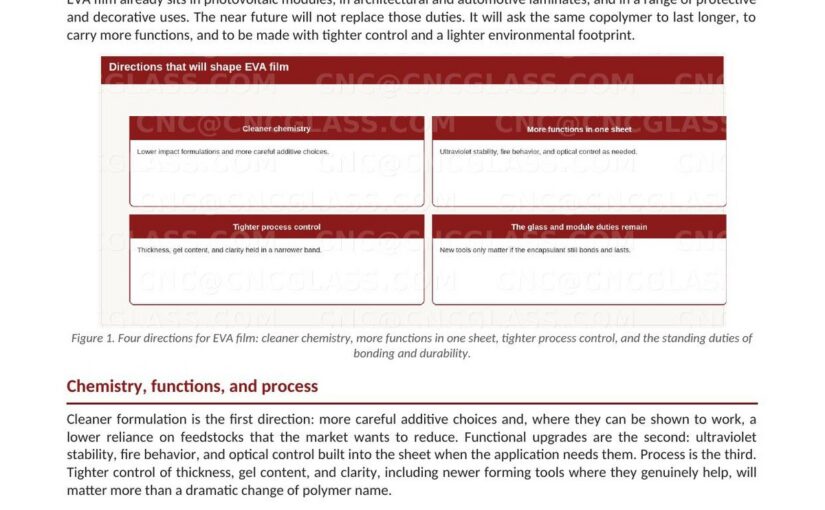
This technical article looks ahead at EVA film rather than treating it as a finished material. The sheet already works in photovoltaic modules, architectural and automotive laminates, and protective or decorative uses. The near future, the article argues, will not replace those duties; it will ask the same copolymer to last longer, to carry more functions, and to be made with tighter control and a lighter environmental footprint.
Three development paths are described. Cleaner formulation means more careful additive choices and, where they can be shown to work, less reliance on feedstocks the market wants to reduce. Functional upgrades such as ultraviolet stability, fire behavior, and optical control can be built into the sheet when the application needs them. Process comes third: tighter control of thickness, gel content, and clarity will matter more than a dramatic change of polymer name.
Demand is also shifting toward appearance and extra functions, not only a basic bond, including more ambitious laminated constructions with glass. The test the article applies is practical: a new direction is real only if the film still bonds, stays clear, and lasts in service. Future EVA grades should therefore be judged by cleaner chemistry, more useful functions, and tighter process control, while still doing the old work of bonding and protection.
