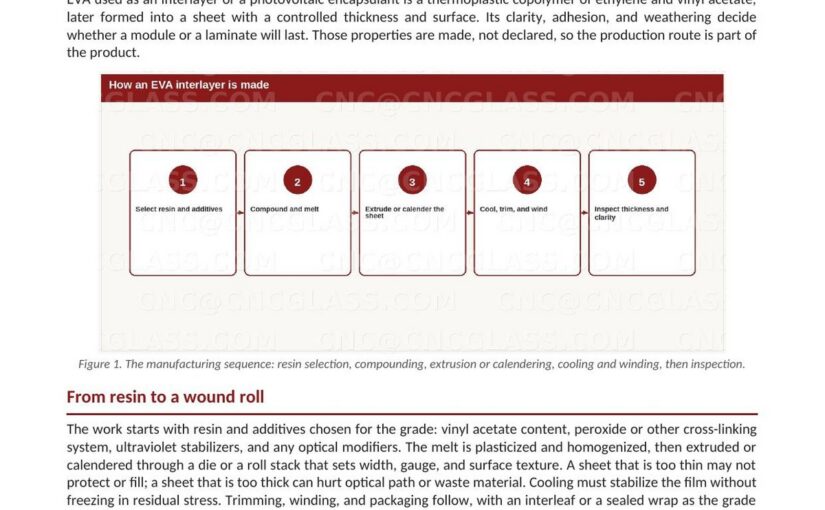
This technical article explains how EVA used as an interlayer or a photovoltaic encapsulant is actually made. The material is a thermoplastic copolymer of ethylene and vinyl acetate, later formed into a sheet with a controlled thickness and surface. Clarity, adhesion, and weathering decide whether a module or a laminate will last, and those properties are made, not simply declared, so the production route is part of the product.
The sequence runs from resin to a wound roll. Resin and additives are chosen for the grade, including vinyl acetate content, a peroxide or other cross-linking system, ultraviolet stabilizers, and any optical modifiers. The melt is plasticized and homogenized, then extruded or calendered through a die or a roll stack that sets width, gauge, and surface texture. A sheet that is too thin may not protect or fill; a sheet that is too thick can hurt the optical path or waste material. Cooling must stabilize the film without freezing in residual stress, after which trimming, winding, and packaging follow.
Quality control sits on every step: incoming resin checks, temperature and pressure in the melt, on-line thickness, and finished-roll tests for clarity, gel potential, and cleanliness. As module and architectural demand grow, the same sequence will be held to tighter gauges and cleaner rooms, but the logic will not change: the roll is only as good as the process that made it. Formulation, melt, forming, cooling, and testing each decide whether the film will bond, stay clear, and last.
