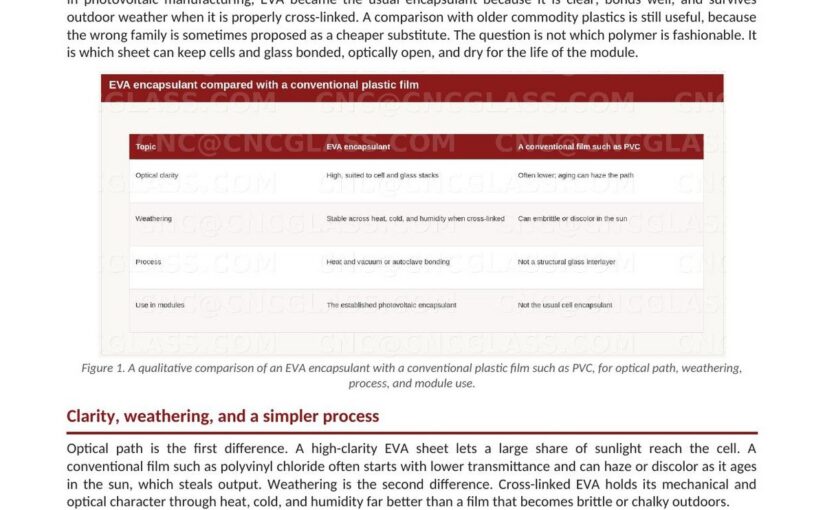
This technical article compares EVA encapsulant film with older commodity plastics in photovoltaic modules. The question it asks is not which polymer is fashionable, but which sheet can keep cells and glass bonded, optically open, and dry for the life of the module, especially when a cheaper conventional film is proposed as a substitute.
Three differences are set out. A high-clarity EVA sheet lets a large share of sunlight reach the cell, while a conventional film such as PVC often starts with lower transmittance and can haze or discolor in the sun. Cross-linked EVA also holds its mechanical and optical character through heat, cold, and humidity better than a film that becomes brittle or chalky outdoors. Process is the third point: EVA is laminated to glass and cells by heat and vacuum, a route module lines already understand, and a packaging plastic is not a drop-in encapsulant.
The article also notes that environment and safety in service should be read from the grade data, not assumed. For crystalline-silicon and many related modules, EVA remains the encapsulant against which alternatives are judged, so a buyer should compare documented module grades rather than generic plastic sheets on price alone.
