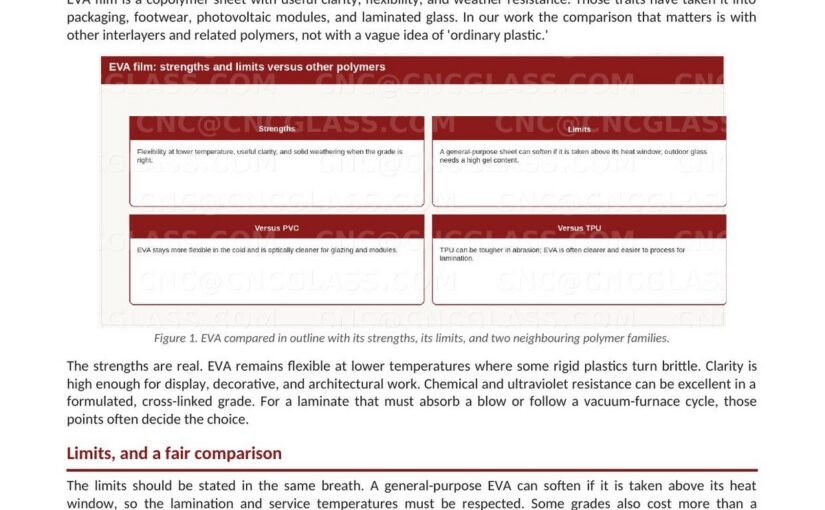
This technical article compares EVA interlayer film with neighbouring polymer families, rather than with a vague idea of ordinary plastic. It treats EVA as a versatile copolymer sheet with useful clarity, flexibility, and weather resistance, used in packaging, footwear, photovoltaic modules, and laminated glass, but not as a perfect material.
The strengths it highlights include flexibility at lower temperatures, clarity high enough for display, decorative, and architectural work, and chemical and ultraviolet resistance in a formulated, cross-linked grade. The limits are stated in the same breath: a general-purpose EVA can soften above its heat window, some grades cost more than a commodity film, and outdoor architectural use requires a high gel content that an interior decorative sheet does not automatically provide.
The comparison is then tied to duty. Against PVC, EVA is typically more flexible in the cold and optically cleaner for glazing and modules; against TPU, TPU can win on abrasion and tear, while EVA is often clearer and easier to process as a laminating film. The article argues that EVA, PVB, ionoplast, or TPU should be compared only after the duty is named.
