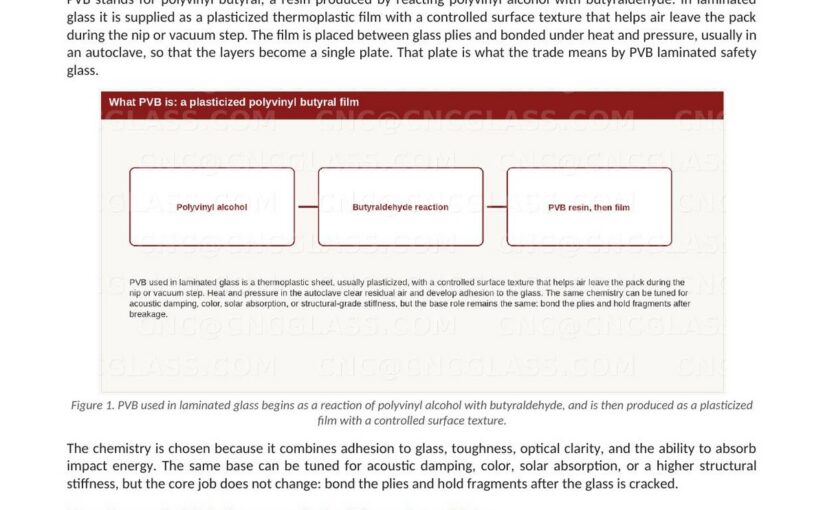
This technical article explains what PVB, or polyvinyl butyral, is and why it became the standard interlayer in laminated safety glass. The resin is made by reacting polyvinyl alcohol with butyraldehyde and is supplied as a plasticized thermoplastic film with a controlled surface texture. Placed between glass plies and bonded under heat and pressure, usually in an autoclave, it turns the layers into a single plate.
The piece describes the core job of that sandwich: the glass may still crack, but the film holds the shards, keeps the opening closed, and absorbs part of the impact energy. It also blocks a large share of ultraviolet radiation and damps sound, which is why PVB is widely used in windshields and in architectural facades, railings, overhead glazing, and partitions.
Honest limits are set out as well. Ordinary PVB is more moisture-sensitive than EVA or ionoplast and is less stiff after lamination than ionoplast sheet, so it is not the first choice where a cracked plate must still carry high structural loads. For most general safety and acoustic work it remains the economical, well-understood default; EVA or ionoplast is suggested when the duty changes.
