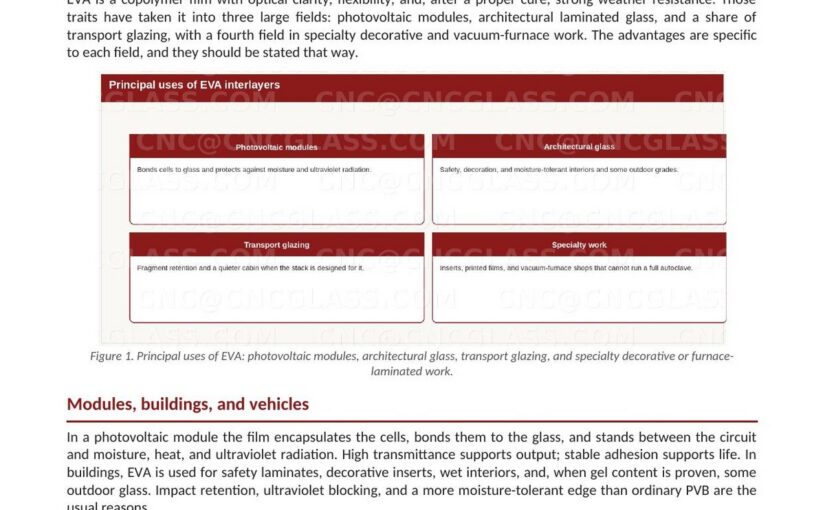
This technical article maps where EVA interlayers are actually used, and why the advantages are specific to each field rather than general. It places the film in three large applications—photovoltaic modules, architectural laminated glass, and a share of transport glazing—plus specialty decorative and vacuum-furnace work.
In a module, EVA encapsulates the cells, bonds them to the glass, and stands between the circuit and moisture, heat, and ultraviolet radiation, with high transmittance supporting output. In buildings, it is used for safety laminates, decorative inserts, wet interiors, and, when gel content is proven, some outdoor glass, often chosen for impact retention, ultraviolet blocking, and a more moisture-tolerant edge than ordinary PVB.
In vehicles, EVA can appear in certain laminated plates, although PVB remains the dominant windshield interlayer. Vacuum-furnace shops use it because they can laminate without an autoclave, and designers use it to enclose fabrics and prints in a cleanable plate. The common caution is to choose a grade that matches the climate and the cycle, rather than assuming one sheet will serve every use.
