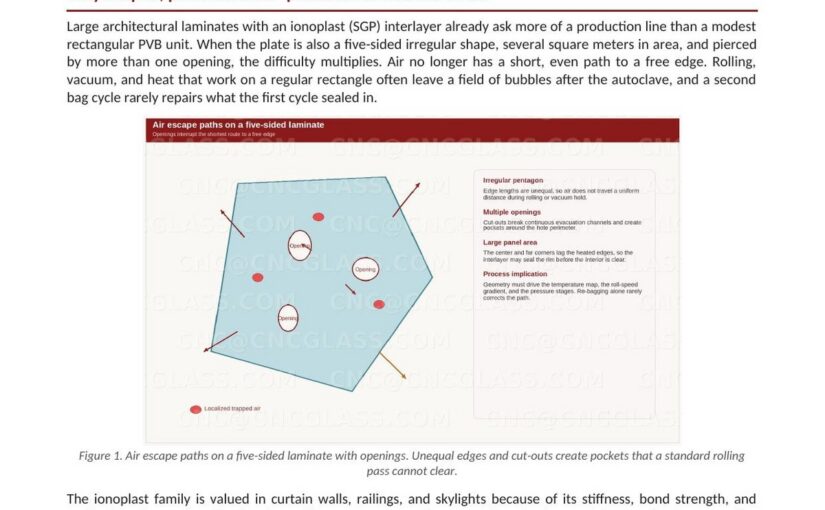
This technical article explains why trapped air is so hard to clear in a large, five-sided, irregular SGP (ionoplast) laminate that also has more than one opening. Air no longer has a short, even path to a free edge, and a rolling or vacuum method that works on a regular rectangle often leaves bubbles after the autoclave.
The piece ties that defect to geometry and material response: unequal edge lengths, cut-outs that interrupt evacuation, and a stiff ionoplast ply that does not flow as freely as a softer film. Heat reaches the rim first, so the perimeter can pinch shut while the center or the glass around an opening is still cool, locking gas in place. A second bag cycle rarely reopens a reliable escape path once that seal has formed.
Correction is described as tuning three levers together: a more even temperature map, a slower rolling-speed gradient that gives air time to leave, and staged pressure so a light pre-press does not turn the rim into a gasket. The article also argues that operators should be able to read the outline, adjust speed before a pocket is sealed, and distinguish a process bubble from contamination, so the next unusual shape can be handled without starting over.
