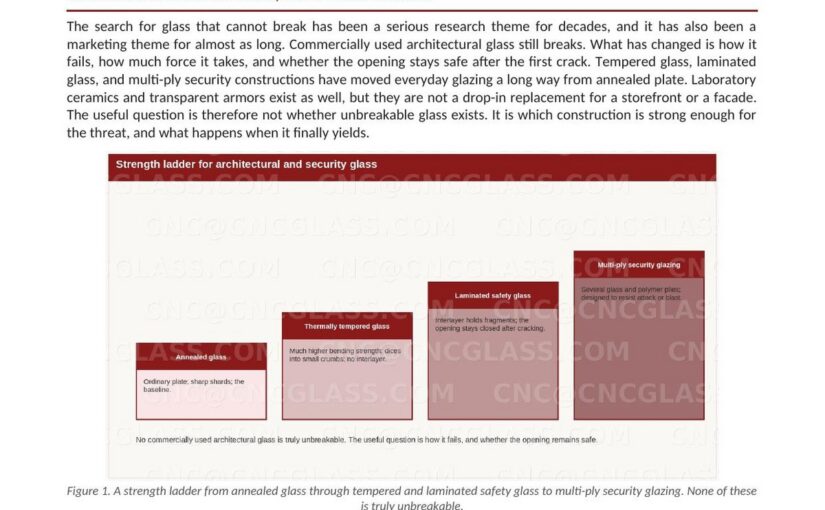
This technical article answers a common search question honestly: commercially used architectural glass still breaks. What has changed is how it fails, how much force it takes, and whether the opening stays safe after the first crack. Unbreakable, the piece argues, is a sales word, not a material state.
It sets out a practical strength ladder from annealed glass through thermally tempered and chemically strengthened glass, then to laminated safety glass and multi-ply security constructions. Laminated glass can still crack, but the interlayer holds fragments, keeps the opening closed, and absorbs part of the impact energy. Resistance is matched to the threat: blunt impact, break-in, wind-borne debris, or, only where tested, ballistic and blast loads.
The article also explains how thickness, interlayer family, and the number of plies should follow the use, from a thinner PVB laminate that slows a casual smash-and-grab to a stiffer ionoplast laminate where the cracked plate must still carry load. For most buildings, laminated safety glass is presented as the closest practical answer to the unbreakable idea, because the opening remains closed after the glass has cracked.
